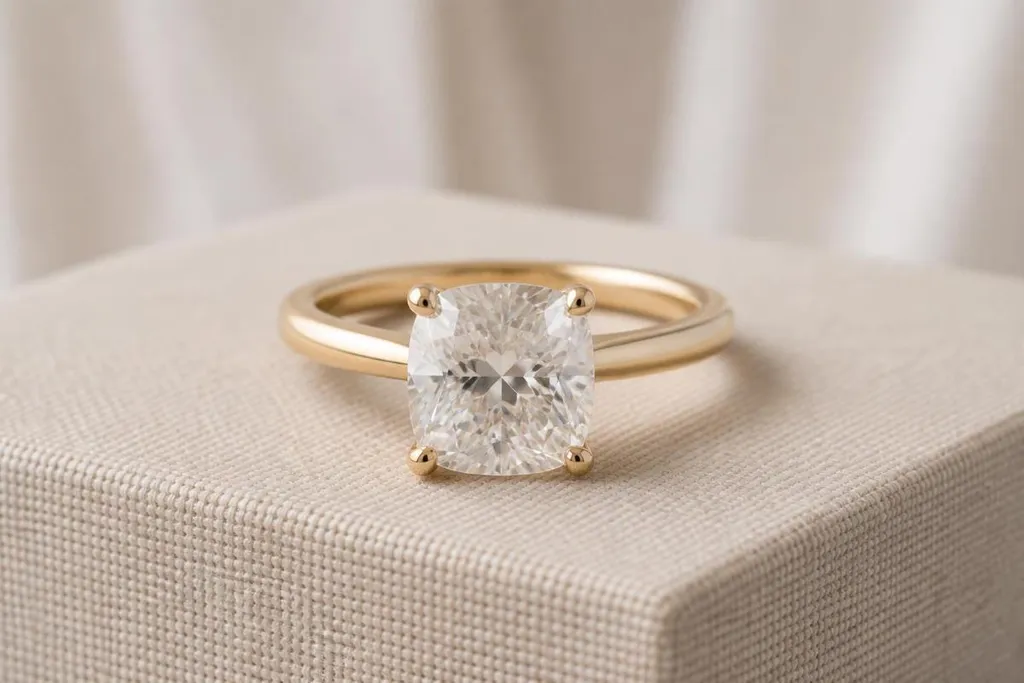
The cushion cut has an unusual ability to feel both romantic and current. Its softened corners recall the character of historic diamond shapes, yet modern faceting can give it the lively brilliance expected from a contemporary engagement ring. This makes it particularly appealing to someone who finds a round diamond too traditional but considers sharp geometric cuts a little too structured.
Browsing beautiful lab diamond cushion cut rings also reveals how varied the shape can be. Some cushion lab diamonds are almost square, while others have distinctly elongated proportions. Their faceting patterns can influence the style of sparkle too, meaning two diamonds described by the same shape and carat weight may look noticeably different once set.
Square or Elongated? Proportion Sets the Mood
A cushion diamond is usually recognised by its broad outline and rounded corners, but there is considerable variation within that definition. Length-to-width ratio is one of the most important distinctions.
Squarer cushions tend to have a balanced, compact appearance. Their symmetry works particularly well for someone seeking a traditional engagement ring silhouette with softer edges. Elongated cushions draw the eye vertically and can create greater visual length across the finger, producing a more contemporary impression.
Neither option is inherently preferable. The wearer's hand and jewellery style matter more than following a particular ratio.
Carat weight should also be judged alongside actual dimensions. Someone might favour a 2-carat elongated cushion because its length provides the finger coverage they want, while another person may choose a smaller square cushion because its proportions look more harmonious with a fine band. The number itself tells only part of the story.
Understanding the Cushion Cut's Sparkle
Cushion-cut diamonds can display different patterns of brilliance depending on their facet arrangement. Some create broader, more defined flashes, while others produce a finer, more fragmented pattern of sparkle.
This is one reason it is useful to assess the diamond visually rather than making a decision entirely from grading figures. The character of the light return can have a significant influence on whether a particular cushion feels crisp, romantic or especially lively.
Clarity also deserves consideration. Cushion cuts can sometimes conceal certain inclusions effectively within their faceting, but every diamond is individual. Rather than automatically pursuing the highest clarity grade, the practical goal is often to find a stone that appears clean to the eye and performs beautifully in ordinary viewing conditions.
Symmetry remains important as well. Rounded corners and curved sides should appear balanced, particularly in squarer cushions where any irregularity may disrupt the otherwise harmonious outline.
Settings Can Make a Cushion Classic or Contemporary
Few diamond shapes respond to their setting as dramatically as the cushion.
A solitaire gives the stone a modern simplicity and makes its rounded outline immediately visible. Pairing it with a fine band can create an especially refined composition, while a slightly broader band adds more visual substance.
Diamond-set shoulders bring additional brilliance without altering the centre stone's outline. A halo takes the design in a more decorative direction, following the cushion's curves and increasing the overall face-up footprint. Hidden halos offer a subtler alternative, introducing diamonds beneath the centre stone while preserving a cleaner appearance from above.
Metal also changes the mood. Platinum and white gold can emphasise the diamond's brightness, while yellow gold creates warmth and contrast. Rose gold complements the cushion's softened outline particularly well for someone seeking a more romantic aesthetic.
Balance Beauty With Everyday Practicality
An engagement ring needs to work beyond photographs and special occasions. Setting height, claw placement and band construction all affect how comfortable a cushion-cut ring feels in daily life. A higher setting can give the centre diamond greater prominence and may make pairing with certain wedding bands easier. A lower profile can be more practical for someone who regularly works with their hands or prefers jewellery that sits closer to the finger.
The wedding ring itself is worth considering early. Depending on the gallery design, a straight band may sit neatly alongside the engagement ring, while other settings may work better with a gently shaped band.
Final Thought
Cushion-cut lab diamond rings owe their versatility to contrast. They combine softened, romantic outlines with the potential for lively modern brilliance, and they can shift easily between minimalist and highly detailed settings.
The strongest choice comes from looking beyond the shape name alone. Consider whether square or elongated proportions feel right, examine the character of the diamond's sparkle and choose a setting that supports its outline. With those elements in balance, the cushion cut offers an engagement style that feels both familiar and distinctly personal.